
Does Anyone Know What This Is? A Tiny Object With a Fascinating Story
Sometimes, the smallest and most ordinary-looking objects can leave us completely puzzled.
That was exactly what happened when a woman came across a strange little item and had absolutely no idea what she was looking at.
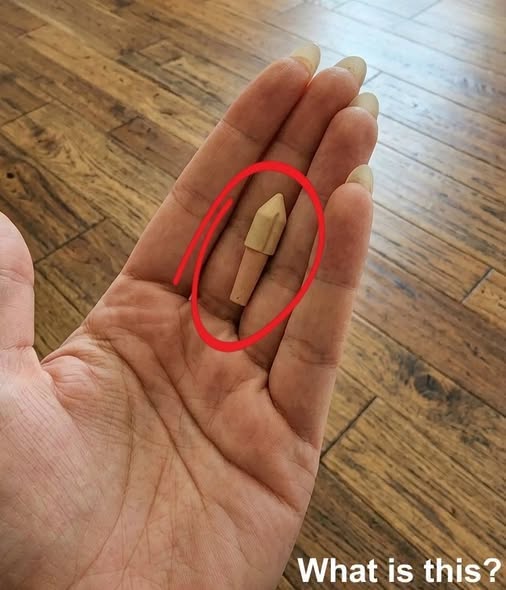
She examined it carefully, turned it over in her hands, and eventually asked the question many people would probably have asked too:
“Does anyone know what this is?”
At first glance, it looked like nothing more than a small, dark piece of material.
But there was much more to it than met the eye.
A Mystery in the Palm of Her Hand
The object was small enough to fit comfortably between her fingers.
It had an unusual appearance and a distinctive texture that made it difficult to identify.
She searched around the house for clues but couldn’t find anything that explained where it came from or what it was used for.
Rather than throwing it away, she decided to ask others.
The photograph quickly attracted attention because many people recognized the object—but not everyone agreed about exactly what they were seeing.
Eventually, the answer began to emerge.
What Was It?
The mysterious object was associated with agarwood, one of the world’s most valued aromatic woods, also known in many cultures as oud.
Agarwood has been used for centuries across parts of Asia and the Middle East for incense, traditional fragrances, and cultural or religious practices.
What makes it particularly interesting is that the fragrant material does not simply come from ordinary healthy wood.
It develops inside certain trees after they experience particular forms of injury and infection.
As the tree responds, it produces a dark, resin-rich material.
That resin is responsible for the powerful aroma that makes agarwood so prized.
Why Is Agarwood So Valuable?
Agarwood has a long history of being considered a luxury aromatic material.
Its fragrance is often described as deep, woody, warm, sweet, smoky, or earthy.
Depending on its origin, age, resin content, and processing, its scent can vary considerably.
High-quality agarwood and oud products can be extremely expensive.
For centuries, the material has been traded throughout Asia and the Middle East and has been incorporated into perfumes, incense, oils, and traditional ceremonies.
Today, oud remains particularly popular in the world of luxury fragrance.
How Does Agarwood Form?
This is perhaps the most fascinating part of the story.
Agarwood generally develops when certain trees in the genus Aquilaria are injured and subsequently affected by microorganisms.
The tree reacts by producing resin around affected areas.
Over time, that resin can accumulate and transform portions of the normally pale wood into a much darker, aromatic material.
Without this process, the wood itself does not have the same distinctive fragrance.
In other words, something that begins as a form of stress for the tree can eventually create one of the most prized aromatic materials in traditional perfumery.
More Than Just an Interesting Scent
Agarwood has played an important role in different cultures for generations.
It has been burned as incense, distilled into aromatic oils, incorporated into perfumes, and used during ceremonies.
In some traditions, its fragrance is associated with relaxation, reflection, hospitality, or spiritual practices.
The scent is also one reason oud has become so popular in modern luxury perfumes.
A tiny amount can create a remarkably strong and distinctive fragrance.
Why People Often Don’t Recognize It
One reason objects like this can be difficult to identify is that agarwood appears in many different forms.
It can be sold as chips of wood, small pieces, beads, incense, powder, oil, or specially prepared aromatic products.
Its appearance can therefore vary significantly.
A small dark piece may look like an ordinary piece of wood to someone unfamiliar with it.
Someone who recognizes the material, however, may immediately notice its characteristic appearance and aroma.
A Reminder That Ordinary Objects Can Have Extraordinary Histories
The mystery surrounding this small object is a good reminder that we often don’t know the history behind the things we encounter.
Something that looks insignificant may have centuries of cultural tradition behind it.
Agarwood is a perfect example.
It comes from trees, develops through a complex natural process, and has been valued for generations because of the fragrance produced by its resin.
What looks like a tiny piece of dark wood can therefore represent an entire world of history, craftsmanship, trade, and tradition.
The Next Time You Find Something Unusual…
Instead of immediately throwing it away, take a closer look.
Ask questions.
Sometimes an unfamiliar object can lead to a fascinating discovery.
And in this case, the simple question “Does anyone know what this is?” opened the door to the story of one of the world’s most intriguing aromatic materials.
Agarwood may not look particularly impressive at first glance.
But once you understand how it forms and why people have valued it for centuries, that little mysterious object suddenly becomes much more interesting.